We accept:


 01706 214 233
Creating an account has many benefits: check out faster, keep more than one address, track orders and more.
Start with the people who shouldn't buy one: if you play a couple of hours a month, if the games you want are console exclusives, or if you need to play somewhere other than a desk, a gaming PC is the wrong purchase and no amount of arithmetic changes that.
For everyone else it comes down to two things: how much you'll actually use it, and whether you'd use it for anything besides games. Play several hours a week and also use it for work, study, editing or anything else that wants a real computer, then yes, you will be justified in getting one. If you lay occasionally but already own a console you're happy with, then probably not, not matter what anyone selling gaming PCs say.
Here's how to work out which of those you are.
People compare purchase prices, but the useful comparison is cost per year of use.
A £1,000 machine kept for 5 years costs £200 a year. That's rough and the assumptions are yours to adjust, but it reframes the question usefully, because £1,000 sounds like a lot and £200 a year sounds like a hobby.
Two things that also be considered before buying: online play doesn't require a subscription on PC, and over 5 years a console subscription adds up to a meaningful share of the hardware cost as a recurring bill rather than a one-off. Games on PC can be cheaper if there are discount sales which happen quite frequently for older games, but all the games are bought through digital keys and not physical discs, while console games can be bought as physical discs or as digital keys. Physical media is great for people who like to collect and display game cases, and another benefit to console games is the 2nd hand market, as you can resell physical media to get money back for what you paid for the game originally. This is great, as discount sales for games aren’t as often for console games as they are for PC. However, while it is currently facing a massive backlash, there are concerns that all console manufacturers will completely abandon physical media, as Sony have announced that they will cease physical media in the future for Playstation consoles.
Unlike a console, a PC doesn't reach a hard end of life; as games require stronger hardware, you only have to replace the PC components that have fallen too far behind, rather than needing to rebuy a whole system every generation like consoles.
A gaming PC is a fast computer, meaning it can handle university work, video editing, photo work, music production, running a business, and anything else that benefits from a good processor and plenty of memory. If you'd otherwise buy a laptop for those things, the PC absorbs that cost rather than adding to it. However, a console is limited in what it can do: only being able to play games and watch videos on certain streaming sites.
So the honest version of the question is usually not "is a gaming PC worth the price" but "is a gaming PC worth the difference between its price and what I'd have to spend on a computer anyway for other uses". That's a much smaller number and a much easier decision, and it's the point that decides it for most people.
If you play a couple of hours a month: The cost per hour gets silly, and a console or cloud streaming will serve you better.
If the games you want are console exclusives: Some games are usually exclusive to a console; for Xbox and Playstation games, they usually release on PC 6 months to a year after releasing on their console and at full price, but consoles like the Nintendo Switch 2 will have games that never come to PC. Check what games you want to play the most rather than assuming that a PC will play everything.
If you mainly play on a sofa with people in the room: Local multiplayer is a console strength and a PC weakness. It's possible but requires to physically move a PC to a big TV and USB/Bluetooth controllers for everyone to play, to replicate a usual console environment. This also adds more costs that you might not think about with PC.
If you don't want to manage anything: When consoles need updating, it is a simple, “press okay and wait” deal, but with PCs, it can be more complicated with updating GPU drives, BIOS updates, etc. Since consoles are made of components optimised to work together and don’t change, PCs can come in different varieties. While PCs sound more daunting, updates have been made easier and it’s not as complicated as it sounds. However, if you really want absolute 0 hassle, get a console.
If the budget won't stretch past the very bottom: With the current component price increases, you can get a current gen console for the same price as an entry-level gaming PC that could only run light games. Therefore, if you are more interested in modern AAA game titles, a console would be better value for the time being.
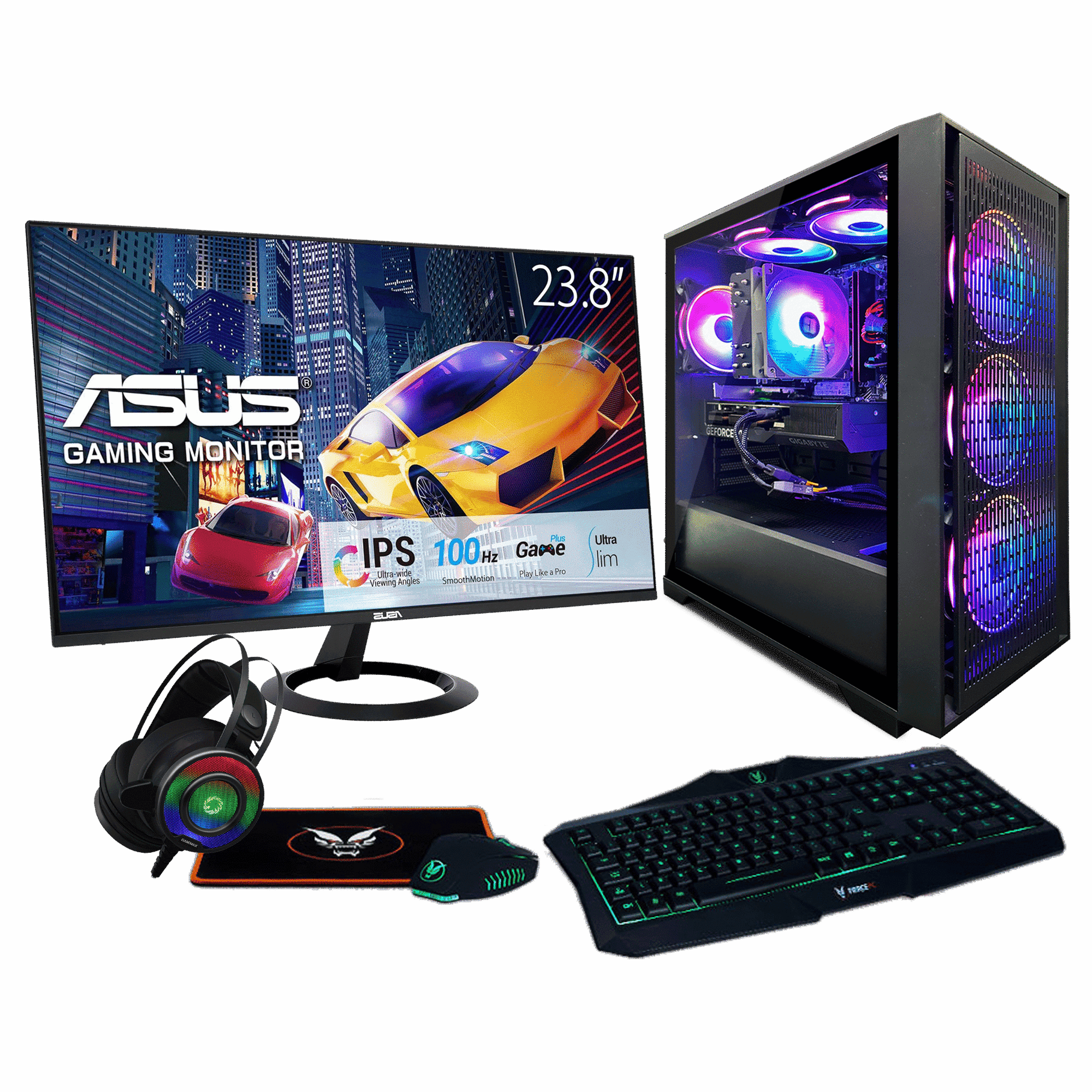
Count these before you commit, because they catch people out: A monitor, if you don't have one, plus keyboard, mouse and headset; together those can add a few hundred pounds, which is why complete bundles exist and are usually the cheaper route if you're starting from nothing. A desk and a chair, if you're setting up somewhere for the PC. Electricity, though less than people assume, since a mid-range machine gaming a couple of hours a day costs a few pounds a month to run. And games, which is obvious and still gets left out of comparisons when people are focused on hardware.
Most people asking this are really asking whether to buy a PC or a console. That's a bigger comparison than fits here, and we've covered it separately in PC vs console gaming.
The short version: a console is cheaper up front, simpler, and better in a living room. A PC costs more initially, costs less to run over time, plays far more games, and serves a dual purpose if you are to use the PC for work. Neither is objectively correct.
Work out what you play and what screen you'll use, then buy for that rather than for the biggest number you can afford.
For lighter games and esports at 1080p, under £1,000 covers it well and is where most first PCs land. For modern games at high settings, with 1440p becoming realistic, look at under £1,500. If you're starting from nothing, price a bundle with the screen and peripherals included against buying the tower alone. And if you already know the parts you want, the PC configurator lets you specify it yourself.
A gaming PC is worth it if you'll use it regularly and it replaces or absorbs the computer you'd have bought anyway. On those terms it's good value, and the ongoing costs are lower than the purchase price suggests. It isn't worth it if you play rarely, if your games are elsewhere, or if you'd resent the small amount of maintenance it asks for. Those are real reasons and they don't make you wrong.
The mistake to avoid isn't buying one. It's buying the wrong one, either by stretching to a machine specced for a screen you don't own, or by spending just little enough that it can't do what you wanted it for. Both are more common than buying a PC and regretting the category.
What to read next


